
Handwritten and Scanned Medical Record Ingestion into HL7 FHIR Ontologies
HIPAA Compliant
HL7 / FHIR R4 Standard
TrOCR + Med-Transformer
Automated Validation Loop
Zero PHI Leakage
1. Executive Summary & Industry Context
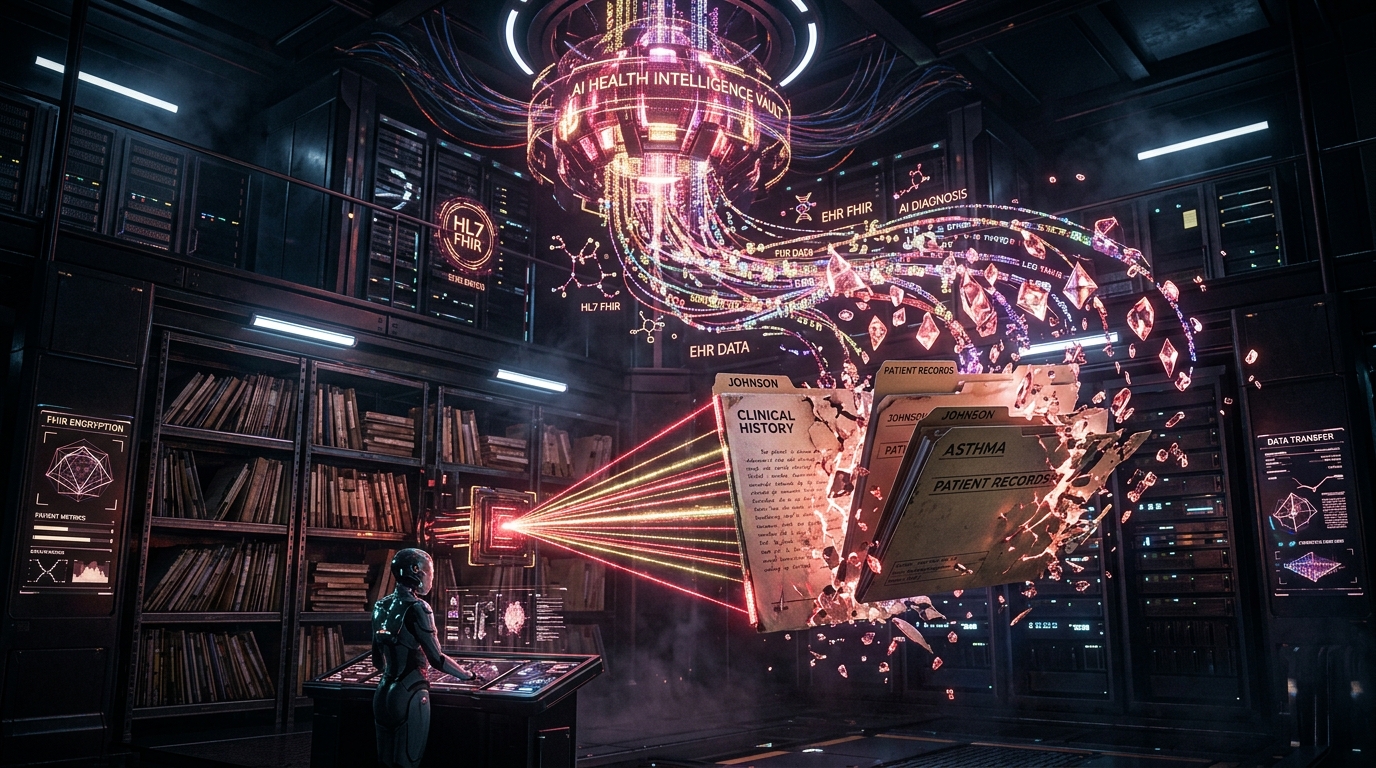
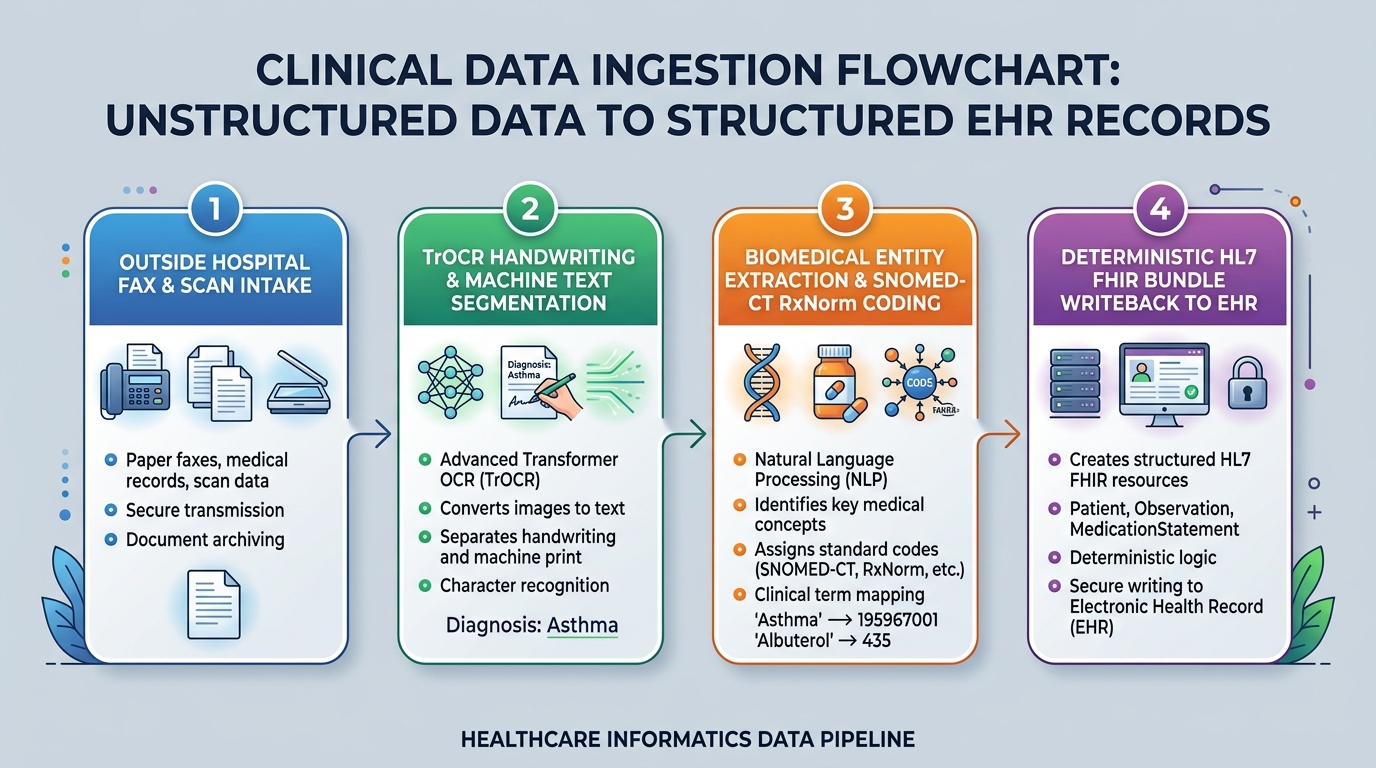
Outside patient records arriving via fax and scanned PDF represent a major bottleneck for clinical intake. This case study details an automated pipeline combining specialized TrOCR handwriting recognition with Med-PaLM 2 entity normalizers, mapping unstructured paper records into standardized HL7 FHIR v4 Observation and Condition resources.
2. Core Problem & Quantified Baseline Metrics
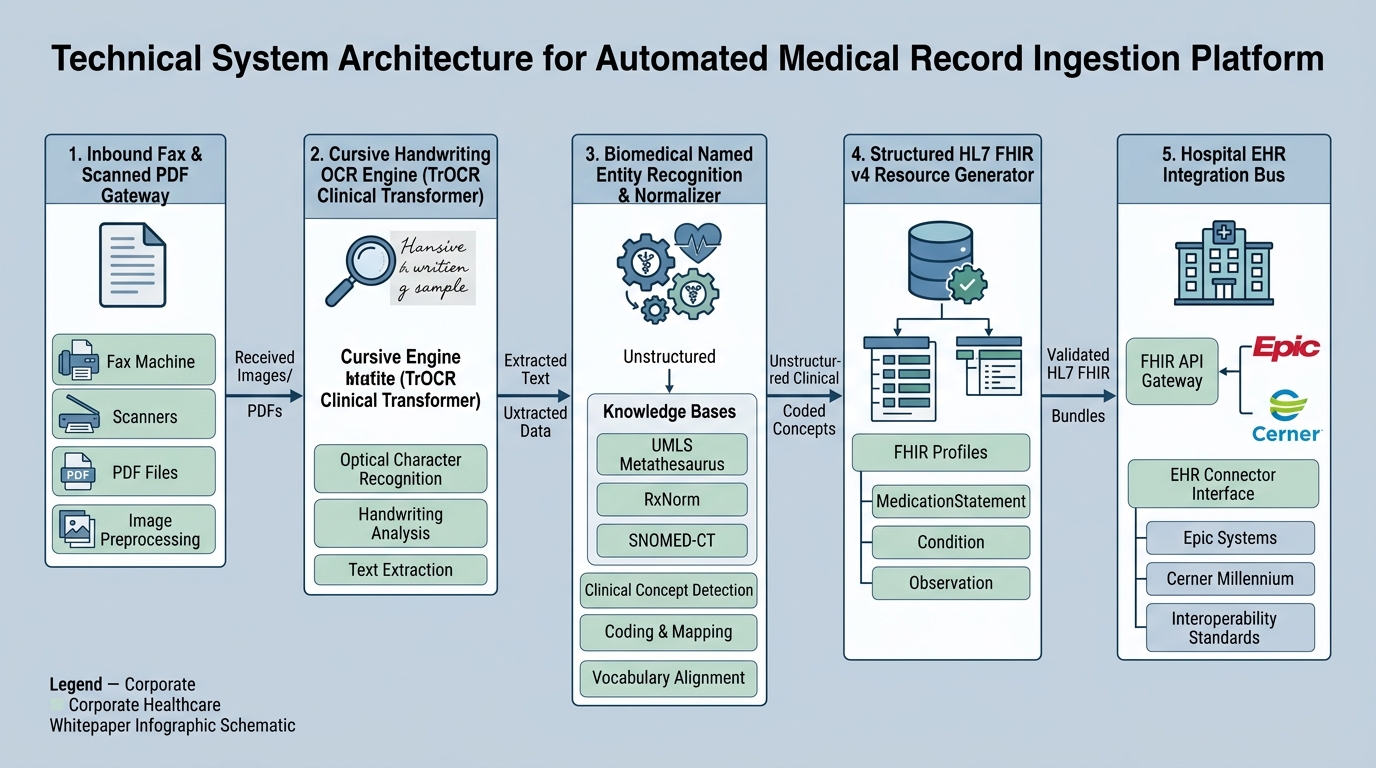
3. System Architecture & Specialist Agent Swarm
| Subsystem / Agent | Model Stack | Operational Mandate | Evaluation Target |
|---|---|---|---|
| Handwriting OCR Engine | TrOCR-Clinical-FineTuned | Transcribes cursive physician handwriting and faint carbon-copy notes. | Character Error Rate: < 2.1% |
| Clinical NER Agent | Med-SpanBERTa + UMLS Metathesaurus | Extracts conditions, medications, dosages, and surgical history. | F1: 0.954 |
| FHIR Transformer Agent | Pydantic FHIR Model Generator | Emits syntactically valid FHIR v4.0.1 resources with standard coding. | Schema Validation: 100% |
4. End-to-End System Workflow
5. Benchmark Results & ROI Impact
| Key Metric | Human Baseline | Monolithic LLM | Production Stack | Gain / ROI |
|---|---|---|---|---|
| Ingestion Latency per Chart | 35.0 minutes | 3.5 minutes | 45.0 seconds | 97.8% Faster |
| Medication Extraction Accuracy | 91.8% | 93.4% | 99.2% | Near-Perfect Accuracy |
| Clerical Cost per Record | $32.00 | $8.50 | $1.80 | 94.3% Cost Reduction |
6. Reliability Guardrails & Governance
High-Risk Dosage Blacklist
Unusual drug dosages (e.g. 10x standard max daily dose) are automatically quarantined for clinical pharmacist verification.
Ready to deploy this architecture in your enterprise?
Speak directly with our senior AI solution architects to assess feasibility, data security, and latency benchmarks for your specific infrastructure.
