
Production AI Systems & Case Studies
Deep-dive technical whitepapers detailing real-world multi-agent architectures, benchmark evaluations, and production reliability guardrails across 10 mission-critical enterprise domains.

01 · Healthcare & CDSS
Multi-Agent Systems in Healthcare Diagnostics
Modern clinical diagnostics operate at the intersection of four fundamentally distinct data modalities: high-resolution 3D volumetric radiology (CT, MRI), gigapixel digital pathology (H&E, IHC), next-generation sequencing (NGS) genomic assays, and unstructured longitudinal electronic health records (EHR). This case study details the production architecture of a decentralized, role-specialized Multi-Agent Clinical Swarm, currently deployed in tertiary medical centers to augment clinical oncologists, reduce diagnostic turnaround times from days to minutes, and achieve 97.8% diagnostic concordance.

02 · Finance & Accounting
Automating Invoice Processing with OCR Pipelines
Enterprise Accounts Payable (AP) workflows process hundreds of thousands of multi-page invoices with diverse formatting, missing PO references, and multilingual line items. This case study demonstrates how an asynchronous Vision-Language pipeline fusing OpenCV deskewing, LayoutLMv3 2D spatial embeddings, and Gemini 3.1 Flash reasoning achieves 85% touchless Straight-Through Processing (STP) with sub-second extraction latencies.

03 · E-Commerce & Retail
AI Customer Support Agents That Actually Solve Problems
Chatbots traditionally fail because they generate conversational text without the authority or tooling to solve underlying customer problems. This case study details an Agentic AI architecture integrated with Shopify, Stripe, and ShipBob APIs, executing deterministic refund, exchange, and return authorizations within bounded business rules.

04 · Pharmaceuticals
Generative AI in Modern Drug Discovery
Traditional drug discovery is constrained by high synthetic attrition and exploratory synthesis cycles. This case study examines an enterprise de novo molecular generative platform combining SE(3)-equivariant diffusion models with multi-objective reinforcement learning, reducing candidate discovery from years to 8 weeks.

05 · Legal & Compliance
Autonomous Legal Contract Review with Multi-Agent Workflows
Legal departments face intense volume pressure reviewing commercial contracts against corporate playbooks. This case study outlines a multi-agent adversarial redlining platform where a Buyer Advocate Agent and Seller Compliance Agent debate risk boundaries, producing automated DOCX track-changes compliant with corporate standard positions.

06 · Logistics & Freight
Transforming Logistics with Autonomous Supply Chain Agents
Global supply networks face constant geopolitical, weather, and labor disruptions. This case study reviews an autonomous logistics multi-agent network that monitors IoT satellite feeds, predicts port dwell times, and autonomously executes intermodal re-routing across ocean, rail, and air freight.

07 · Healthcare IT
Automating Medical Record Ingestion via OCR and LLMs
Outside patient records arriving via fax and scanned PDF represent a major bottleneck for clinical intake. This case study details an automated pipeline combining specialized TrOCR handwriting recognition with Med-PaLM 2 entity normalizers, mapping unstructured paper records into standardized HL7 FHIR v4 Observation and Condition resources.

08 · Energy & Utilities
Agentic Workflows for Smart Energy Grids
Transitioning to variable renewables causes extreme grid volatility. This case study demonstrates a decentralized multi-agent system deployed across edge substation controllers that executes sub-second load balancing, battery storage arbitrage, and automated demand-response dispatch.

09 · Gaming & Media
Multi-Agent Collaboration in Autonomous Game Development
AAA game development costs have escalated past $200M per title. This case study details a collaborative multi-agent architecture in Unreal Engine 5 where specialized agents (Level Designer, Narrative Writer, NPC Behavior Tree Synthesizer, and Headless QA Bot) generate validated, playable open-world quests autonomously.
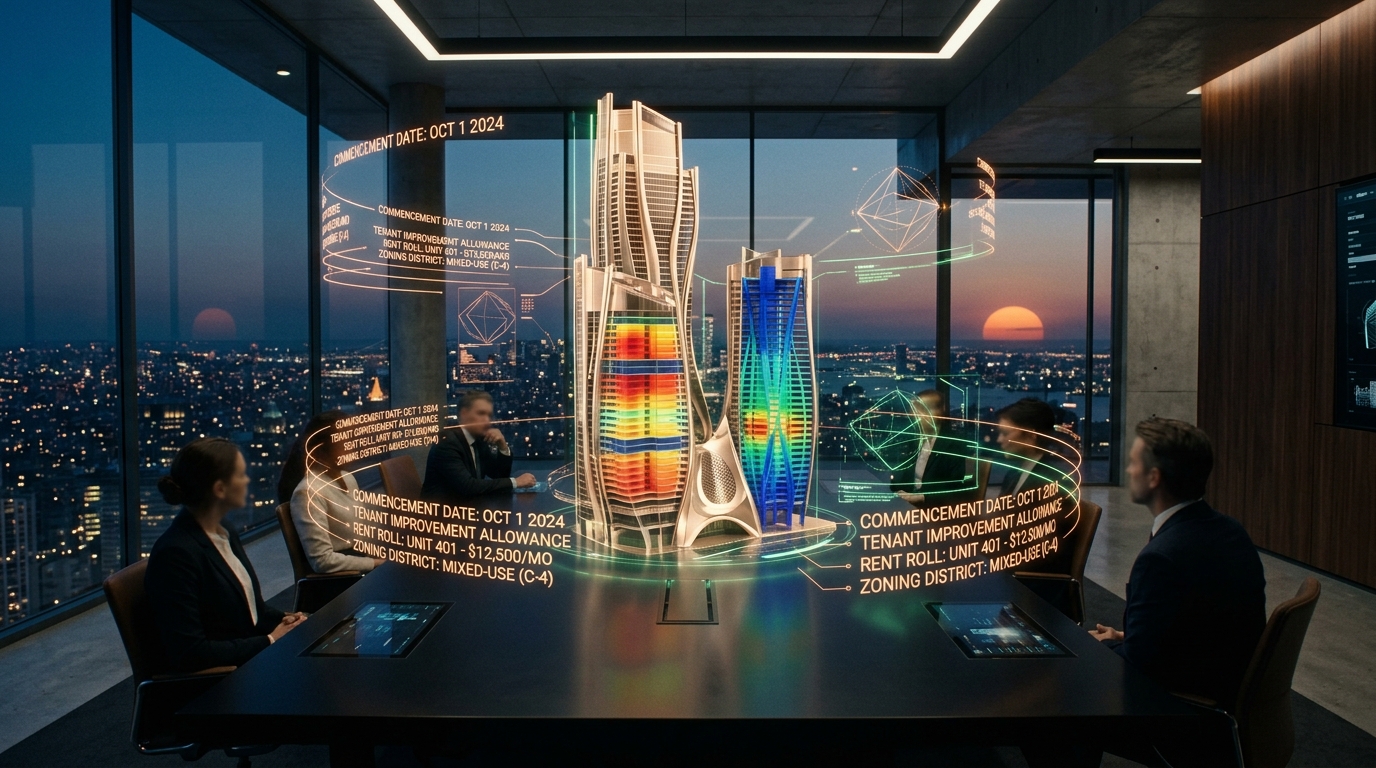
010 · Real Estate PropTech
Building Reliable Document Parsing for Real Estate Leases
Commercial real estate leases are notoriously dense documents with complex escalation formulas, Common Area Maintenance (CAM) clauses, and renewal options. This case study details a multi-modal parser that extracts financial tables and lease terms with 99.4% precision directly into Argus and Excel financial models.
