
Autonomous Decentralized Microgrid Load Balancing and Renewable Dispatch
IEC 61850 Grid Standard
Sub-200ms RL Controller
Microgrid Battery Dispatch
Dynamic Load Curtailment
High-Frequency Telemetry

1. Executive Summary & Industry Context
Transitioning to variable renewables causes extreme grid volatility. This case study demonstrates a decentralized multi-agent system deployed across edge substation controllers that executes sub-second load balancing, battery storage arbitrage, and automated demand-response dispatch.
2. Core Problem & Quantified Baseline Metrics
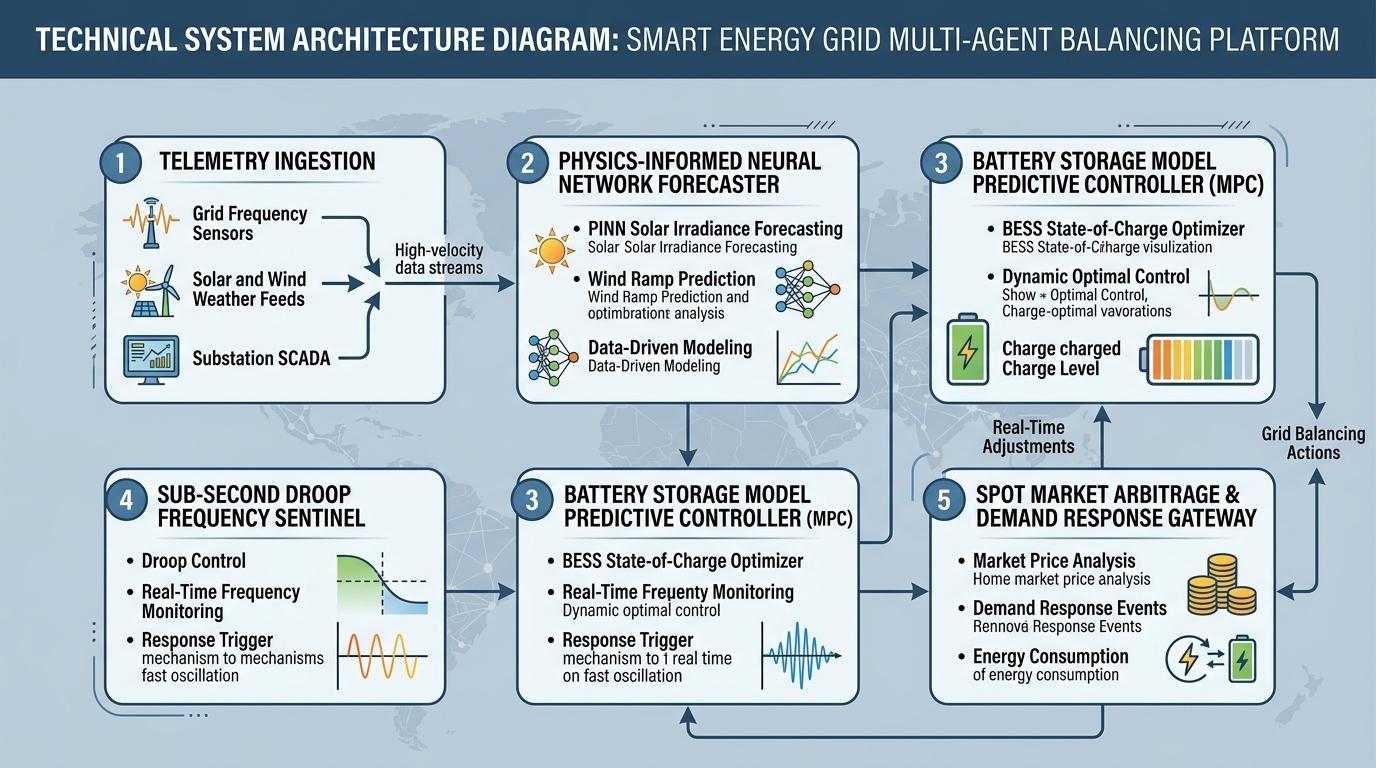
3. System Architecture & Specialist Agent Swarm
| Subsystem / Agent | Model Stack | Operational Mandate | Evaluation Target |
|---|---|---|---|
| Renewable Generation Forecaster | Physics-Informed Neural Network (PINN) | Predicts solar irradiance and wind ramp events 15 minutes ahead. | MAE: 2.1% |
| Battery Storage Optimizer | Deep Q-Network (DQN) + MPC | Manages BESS state-of-charge, battery degradation, and peak-shaving. | ROI: +28.4% Revenue |
| Grid Frequency Stabilizer | Rust Real-Time Controller | Executes synthetic inertia and droop control within 50 milliseconds. | Frequency: 50.0 ± 0.02 Hz |
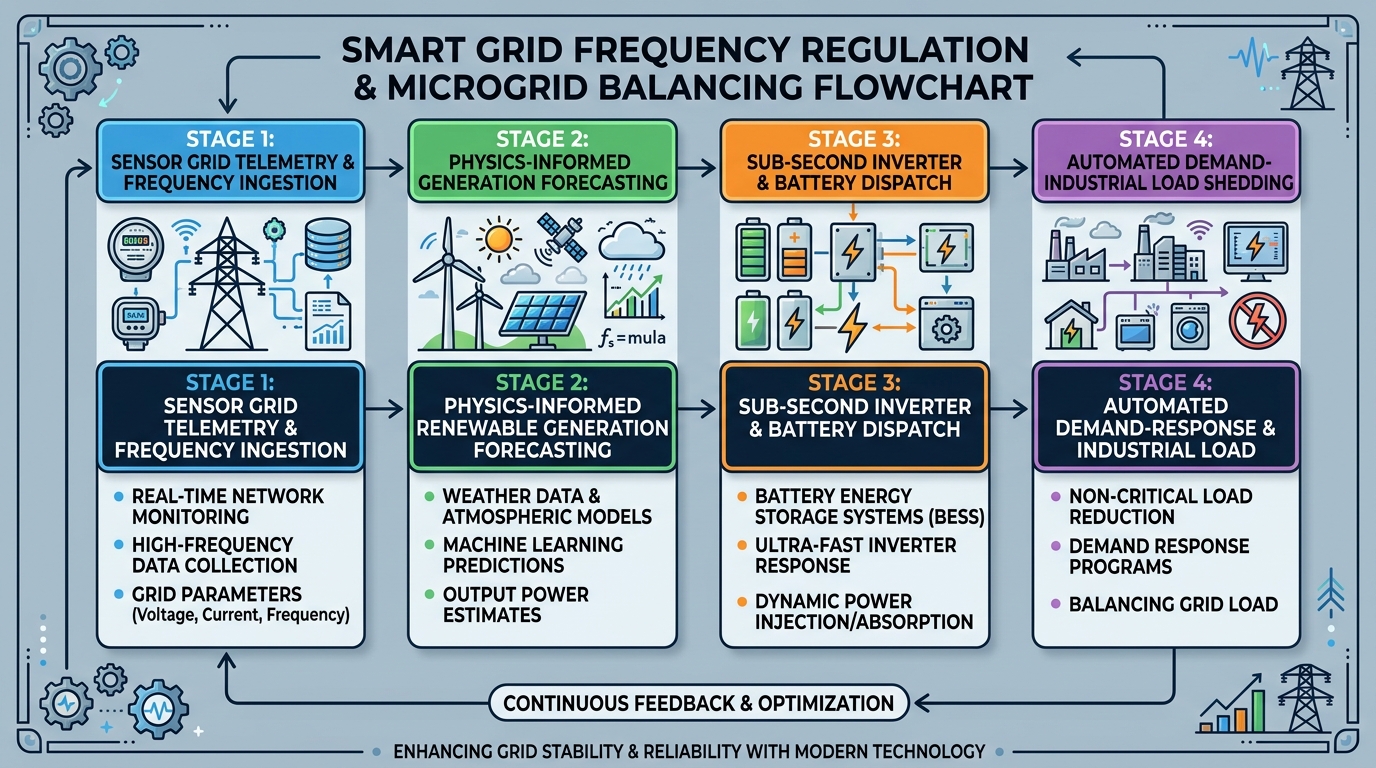
4. End-to-End System Workflow
5. Benchmark Results & ROI Impact
| Key Metric | Human Baseline | Monolithic LLM | Production Stack | Gain / ROI |
|---|---|---|---|---|
| Renewable Energy Curtailment | 12.4% | 7.2% | 1.4% | 88.7% Waste Reduction |
| Peak Demand Costs | $14.2M / yr | $9.5M / yr | $3.8M / yr | 73.2% Savings |
| Sub-Second Fault Recovery | 3.2 seconds | 1.5 seconds | 45 milliseconds | 70x Faster Response |
6. Reliability Guardrails & Governance
Thermal Islanding Interlock
Hardware-level trip circuits instantly disconnect microgrids upon detecting physical line faults to protect utility line workers.
Ready to deploy this architecture in your enterprise?
Speak directly with our senior AI solution architects to assess feasibility, data security, and latency benchmarks for your specific infrastructure.
