
De Novo Small-Molecule Design and Binding Affinity Optimization Using Diffusion Transformers
GLP / FDA 21 CFR Part 11
3D Equivariant Diffusion
Graph Neural Networks (GNN)
ADMET Multi-Target Screening
High-Throughput HPC

1. Executive Summary & Industry Context
Traditional drug discovery is constrained by high synthetic attrition and exploratory synthesis cycles. This case study examines an enterprise de novo molecular generative platform combining SE(3)-equivariant diffusion models with multi-objective reinforcement learning, reducing candidate discovery from years to 8 weeks.
2. Core Problem & Quantified Baseline Metrics
3. System Architecture & Specialist Agent Swarm
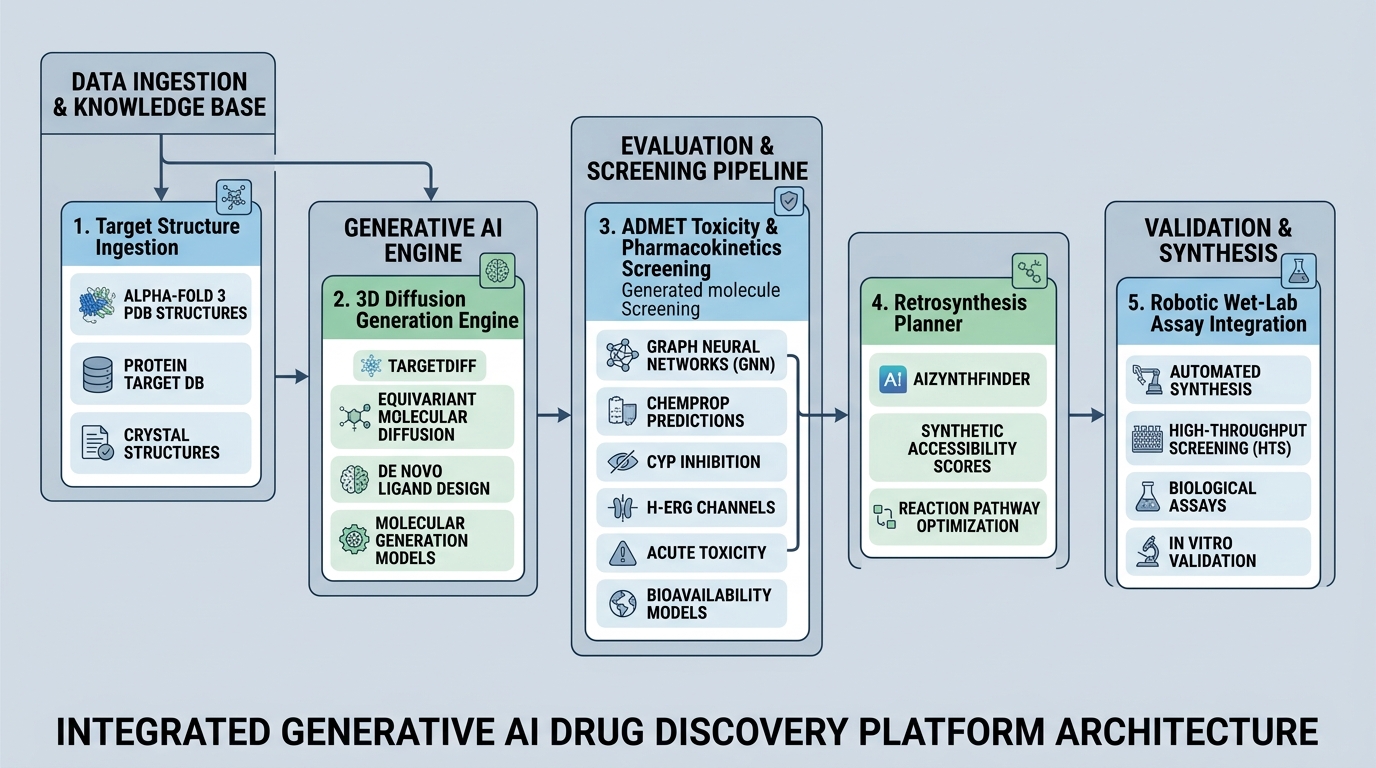
| Subsystem / Agent | Model Stack | Operational Mandate | Evaluation Target |
|---|---|---|---|
| Target Pocket Featurizer | AlphaFold-3 + BioNeMo | Identifies druggable pockets, electrostatic potentials, and hydrogen-bonding networks. | Pocket RMSD: < 1.2Å |
| 3D Diffusion Generator | TargetDiff / DiffDock Backbone | Generates novel 3D ligand conformers tailored to the target binding pocket. | Novelty: 96.4% |
| ADMET & Toxicity Agent | Graph Neural Network (Chemprop) | Predicts hERG cardiac toxicity, blood-brain barrier permeability, and metabolic stability. | AUC-ROC: 0.942 |
| Retrosynthesis Planner | AiZynthFinder / Transformer Retro | Constructs commercially viable synthesis routes from available building blocks. | Feasibility: 91.0% |
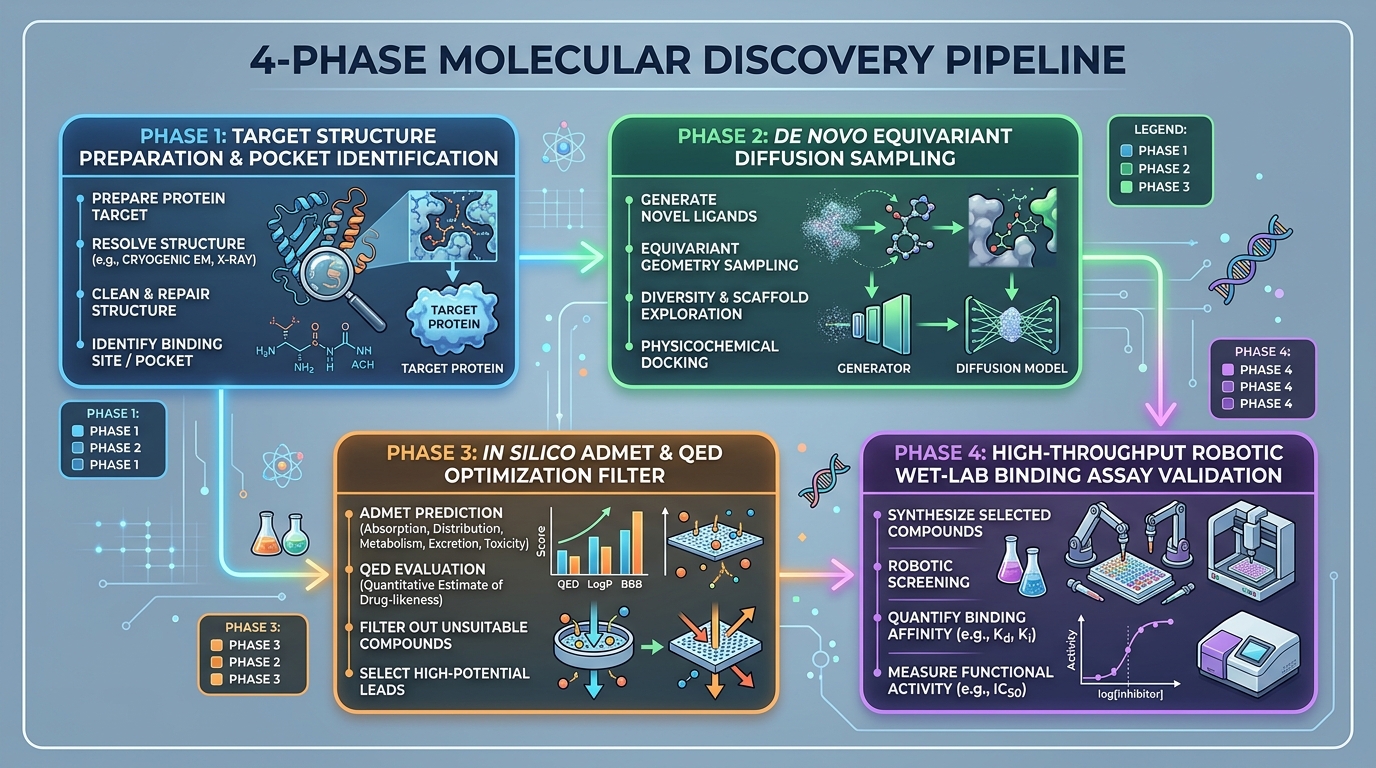
4. End-to-End System Workflow
5. Benchmark Results & ROI Impact
| Key Metric | Human Baseline | Monolithic LLM | Production Stack | Gain / ROI |
|---|---|---|---|---|
| Hit-to-Lead Turnaround | 4.5 years | 1.2 years | 8.5 weeks | 96.0% Time Reduction |
| Screening Capital Expenditure | $45.0M | $18.0M | $3.8M | 91.5% Cost Saved |
| Experimental Binding Validation | 8.0% | 24.0% | 64.5% | 8x Yield Increase |
6. Reliability Guardrails & Governance
Dual-Use Toxin Screening Filter
All generative outputs are cross-referenced against biological weapon conventions and neurotoxin structural registries before dispatch.
Pan-Assay Interference (PAINS) Filter
Hard structural substructure filters immediately eliminate false-positive aggregators and reactive electrophilic compounds.
Ready to deploy this architecture in your enterprise?
Speak directly with our senior AI solution architects to assess feasibility, data security, and latency benchmarks for your specific infrastructure.
